Patients with HES are characterized by1,2:
- Sustained hypereosinophilia (AEC ≥1500 cells/µL on 2 examinations ≥2 weeks apart)
- Hypereosinophilia and eosinophil-mediated organ damage/dysfunction not caused by other conditions*


Patients with HES are characterized by1,2:
In patients with HES, eosinophilic inflammation leads to organ damage—often in more than one organ system.2
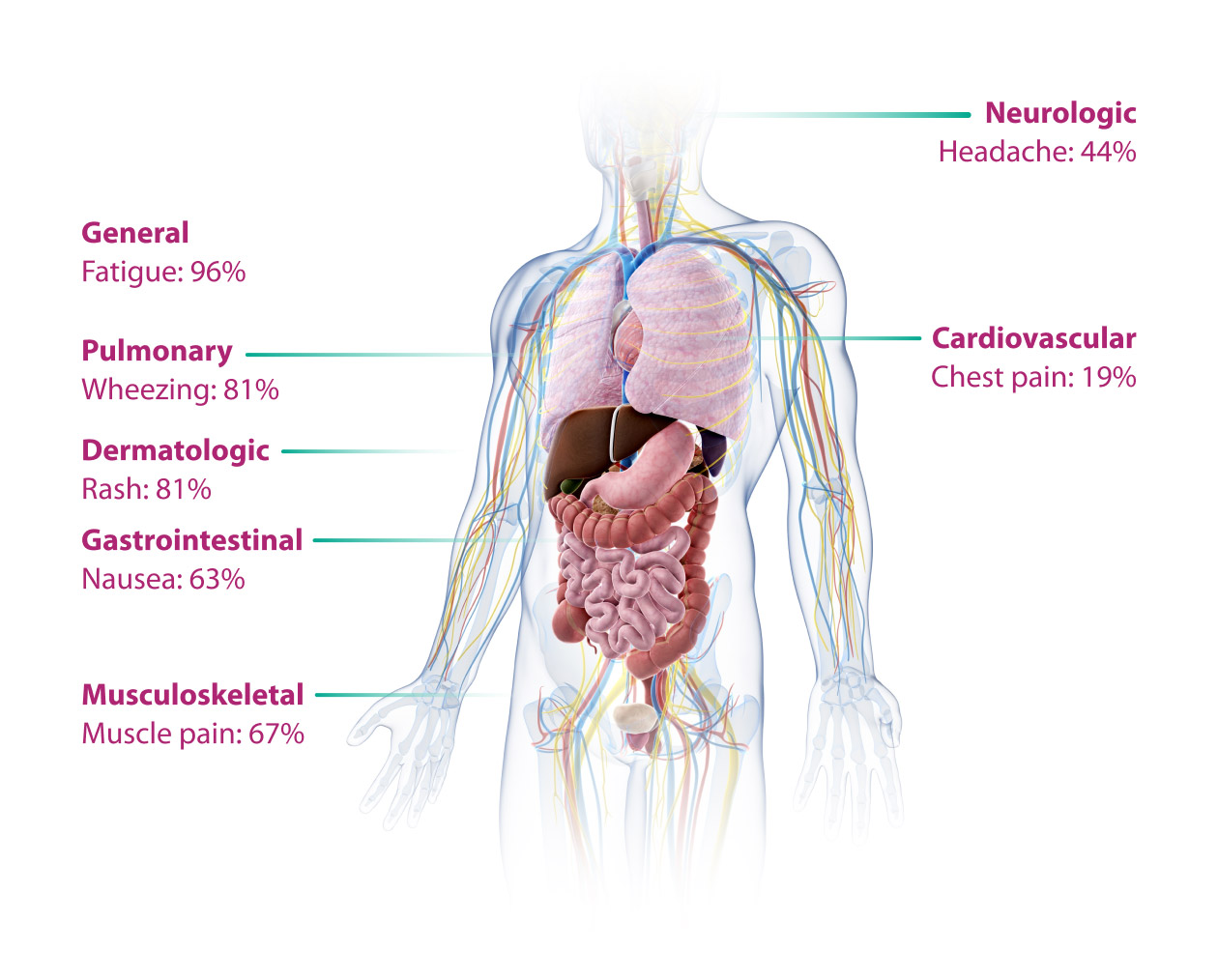
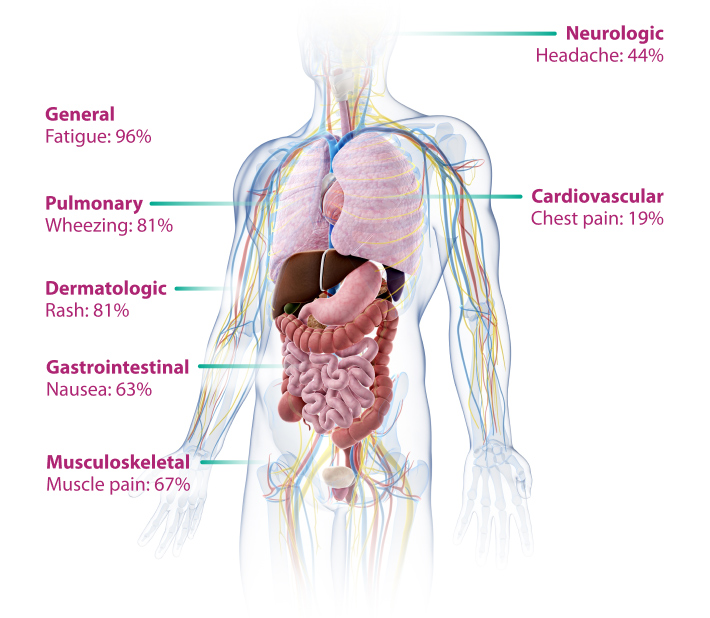
More than 50% of patients exhibited damage in ≥3 organ systems in a retrospective study§4
In patients with HES, eosinophilic inflammation leads to organ damage—often in more than one organ system.2
*Other conditions may include allergies, infections, or autoimmune disorders.1,2
†Percentages reflect the proportion of surveyed U.S. respondents with self-reported HES who endorsed specific symptoms in a one-time, 104-item online questionnaire administered via APFED (February–May 2022). Symptoms are not mutually exclusive. Figures represent descriptive, patient-reported data and may be subject to recall bias.3
‡Symptom category labels align with domain names from the survey as follows: cardiovascular=circulatory symptoms; dermatologic=integumentary symptoms; gastrointestinal=digestive symptoms; musculoskeletal=muscular symptoms; neurologic=nervous system symptoms; pulmonary=respiratory symptoms.3
§Based on data from a real-world retrospective study on disease burden and clinical characteristics in patients with idiopathic HES (I-HES) or lymphocytic HES (L-HES).4
AEC, absolute eosinophil count; APFED, American Partnership for Eosinophilic Disorders.
Known hypersensitivity to benralizumab or excipients.
Hypersensitivity reactions (eg, anaphylaxis, angioedema, urticaria, rash) have occurred after administration of FASENRA. These reactions generally occur within hours of administration, but in some instances have a delayed onset (ie, days). Discontinue in the event of a hypersensitivity reaction.
FASENRA should not be used to treat acute asthma symptoms, acute exacerbations, or acute bronchospasm.
Do not discontinue systemic or inhaled corticosteroids abruptly upon initiation of therapy with FASENRA. Reductions in corticosteroid dose, if appropriate, should be gradual and performed under the direct supervision of a physician. Reduction in corticosteroid dose may be associated with systemic withdrawal symptoms and/or unmask conditions previously suppressed by systemic corticosteroid therapy.
It is unknown if FASENRA will influence a patient’s response against helminth infections. Treat patients with pre-existing helminth infections before initiating therapy with FASENRA. If patients become infected while receiving FASENRA and do not respond to anti-helminth treatment, discontinue FASENRA until infection resolves.
The most common adverse reactions (incidence ≥ 5%):
Injection site reactions (eg, pain, erythema, pruritus, papule) occurred at a rate of 2.2% in patients treated with FASENRA compared with 1.9% in patients treated with placebo in asthma exacerbation studies.
The data on pregnancy exposure from the clinical trials are insufficient to inform on drug-associated risk. Monoclonal antibodies such as benralizumab are transported across the placenta during the third trimester of pregnancy; therefore, potential effects on a fetus are likely to be greater during the third trimester of pregnancy.
FASENRA is indicated for:
Please read full Prescribing Information, including Patient Information.
You may report side effects related to AstraZeneca products  .
.
1. FASENRA® (benralizumab) [package insert]. Wilmington, DE: AstraZeneca Pharmaceuticals LP; 2026.
1. FASENRA® (benralizumab) [package insert]. Wilmington, DE: AstraZeneca Pharmaceuticals LP; 2026.
2. Ogbogu PU, Roufosse F, Akuthota P, et al. Benralizumab versus placebo for hypereosinophilic syndrome: a randomized, placebo-controlled phase 3 trial. Nat Med. Published online March 31, 2026. doi:10.1038/s41591-026-04315-8 3. Ogbogu PU, Roufosse F, Akuthota P, et al. Benralizumab versus placebo for hypereosinophilic syndrome: a randomized, placebo-controlled phase 3 trial. Nat Med. Supplementary information published online March 31, 2026. doi:10.1038/s41591-026-04315-8
1. Khoury P, Akuthota P, Kwon N, Steinfeld J, Roufosse F. HES and EGPA: two sides of the same coin. Mayo Clin Proc. 2023;98(7):1054-1070. 2. Valent P, Klion AD, Roufosse F, et al. Proposed refined diagnostic criteria and classification of eosinophil disorders and related syndromes. Allergy. 2023;78(1):47-59. 3. Silver J, Kovalszki A, Strobel MJ, et al. Burden of hypereosinophilic syndromes in the United States: patients' perspective. J Allergy Clin Immunol Glob. 2025;4(3):100501. 4. Dolin P, Pongdee T, Jain P, et al. Disease burden of idiopathic and lymphocytic hypereosinophilic syndrome in the United States: evidence from a real-world retrospective study of de-identified electronic health records and insurance claims. Poster presented at: The American Society of Hematology Annual Meeting; December 7–10, 2024; San Diego, CA. Poster 2316.
1. FASENRA® (benralizumab) [package insert]. Wilmington, DE: AstraZeneca Pharmaceuticals LP; 2026.
1. FASENRA® (benralizumab) [package insert]. Wilmington, DE: AstraZeneca Pharmaceuticals LP; 2026.
2. Ogbogu PU, Roufosse F, Akuthota P, et al. Benralizumab versus placebo for hypereosinophilic syndrome: a randomized, placebo-controlled phase 3 trial. Nat Med. Published online March 31, 2026. doi:10.1038/s41591-026-04315-8 3. Ogbogu PU, Roufosse F, Akuthota P, et al. Benralizumab versus placebo for hypereosinophilic syndrome: a randomized, placebo-controlled phase 3 trial. Nat Med. Supplementary information published online March 31, 2026. doi:10.1038/s41591-026-04315-8
1. FASENRA® (benralizumab) [package insert]. Wilmington, DE: AstraZeneca Pharmaceuticals LP; 2026.
2. Ogbogu PU, Roufosse F, Akuthota P, et al. Benralizumab versus placebo for hypereosinophilic syndrome: a randomized, placebo-controlled phase 3 trial. Nat Med. Published online March 31, 2026. doi:10.1038/s41591-026-04315-8
1. Ogbogu PU, Roufosse F, Akuthota P, et al. Benralizumab versus placebo for hypereosinophilic syndrome: a randomized, placebo-controlled phase 3 trial. Nat Med. Published online March 31, 2026. doi:10.1038/s41591-026-04315-8 2. FASENRA® (benralizumab) [package insert]. Wilmington, DE: AstraZeneca Pharmaceuticals LP; 2026. 3. Data on File, US-107579, AZPLP.
1. FASENRA® (benralizumab) [package insert]. Wilmington, DE: AstraZeneca Pharmaceuticals LP; 2026.
2. Ogbogu PU, Roufosse F, Akuthota P, et al. Benralizumab versus placebo for hypereosinophilic syndrome: a randomized, placebo-controlled phase 3 trial. Nat Med. Published online March 31, 2026. doi:10.1038/s41591-026-04315-8 3. Ogbogu PU, Roufosse F, Akuthota P, et al. Benralizumab versus placebo for hypereosinophilic syndrome: a randomized, placebo-controlled phase 3 trial. Nat Med. Supplementary information published online March 31, 2026. doi:10.1038/s41591-026-04315-8
1. FASENRA® (benralizumab) [package insert]. Wilmington, DE: AstraZeneca Pharmaceuticals LP; 2026.
2. Nucala® (mepolizumab) [package insert]. Philadelphia, PA: GlaxoSmithKline LLC; August 2025.


