

NATRON was a randomized, double-blind, parallel-group, placebo-controlled, 24-week, Phase 3 clinical trial that evaluated the efficacy and safety of FASENRA to placebo in patients aged 12 or older who had signs or symptoms of HES flare or had experienced at least 2 HES flares within the past 12 months. After a 2-day course of OCS (1 mg/kg/day), patients demonstrating absolute eosinophil count (AEC) <1000 cells/µL were randomized (1:1) to FASENRA (30 mg subcutaneously) or placebo every 4 weeks for 24 weeks, plus background therapy.*1,2
Study Overview1-3

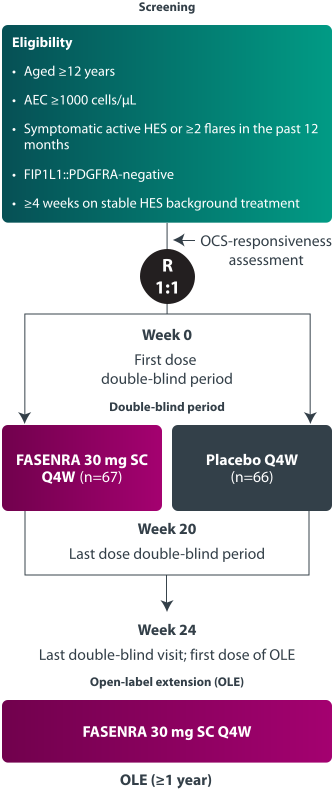
OCS-RESPONSIVENESS ASSESSMENT2:
Before randomization, patients were required to demonstrate OCS responsiveness, which was defined as an AEC <1000 cells/µL after receiving 1 mg/kg/day prednisone/prednisolone equivalent for 2 days.
PRIMARY ENDPOINT2:
Time to first HES flare during the double-blind period.
KEY SECONDARY ENDPOINTS2:
- Proportion of patients with an HES flare
- Annualized rate of HES flares
- Change from baseline in fatigue severity
KEY TERMS:
HES flare is defined as a clinical manifestation or laboratory abnormality leading to an increase/addition of OCS (≥10 mg/day prednisolone equivalent for ≥2 days) OR cytotoxic and/or immunosuppressive HES therapy; OR hospitalization.1,2
Select Baseline Characteristics2
| Characteristic | FASENRA (n=67) |
Placebo (n=66) |
|---|---|---|
| Median age, years (range) |
49 (14-87) | 54 (16-83) |
| Female, n (%) | 43 (64) | 39 (59) |
| Time since first appearance of HES symptoms (years), median (range)† |
6 (0.5-40) | 4 (0.5-37) |
| Time since HES diagnosis (years), median (range)‡ |
2 (0.1-32) | 2 (0.1-25) |
| Absolute eosinophil count (cells/µL), median (range) at screening§ |
1600 (1000-10,250) | 1550 (1000-25,150) |
| HES subtypes, n (%) | ||
| I-HES | 49 (73) | 51 (77) |
| L-HES | 5 (8) | 11 (17) |
| SO-HES¶ | 10 (15) | 3 (5) |
| EGPA/HES overlap# | 3 (5) | 0 |
| Unknown | 0 | 1 (2) |
| HES primary organ involvement, n (%)** | ||
| Pulmonary | 34 (51) | 42 (64) |
| Dermatologic | 33 (49) | 37 (56) |
| Gastrointestinal | 33 (49) | 30 (46) |
| Musculoskeletal | 25 (37) | 24 (36) |
| Sinus | 25 (37) | 20 (30) |
| Cardiac | 7 (10) | 6 (9) |
| Neurologic | 6 (9) | 9 (14) |
| Other | 11 (16) | 10 (15) |
| Number of HES flares in the previous 12 months, n (%) | ||
| Median (range) | 2 (0-12) | 2 (1-12) |
| 0 | 1 (2) | 0 |
| 1 | 13 (19) | 13 (20) |
| 2 | 28 (42) | 30 (46) |
| ≥3 | 25 (37) | 23 (35) |


*Patients remained on stable HES therapy (which could include OCS and/or immunosuppressive/cytotoxic therapy) throughout the study.2
†The time to first appearance of HES symptoms (years) = (date of randomization - start date of HES worsening + 1)/365.25.2
‡Time since HES diagnosis (years) = (date of randomization - date of HES diagnosis + 1)/365.25.2
§Eosinophil count prior to OCS-responsiveness assessment and randomization.2
OCS, oral corticosteroid; OLE, open-label extension; Q4W, every 4 weeks; SC, subcutaneous.


