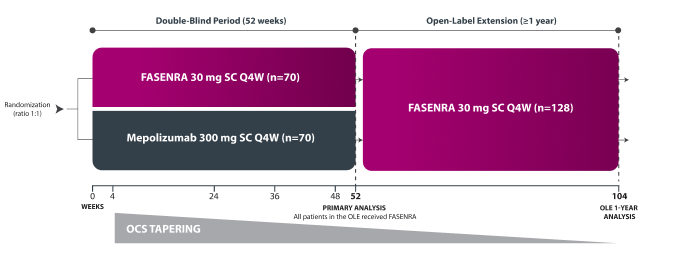
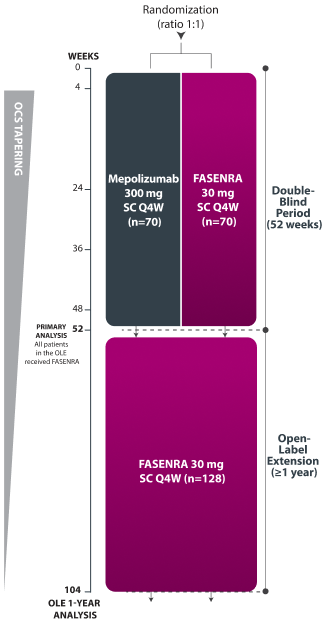
The MANDARA clinical trial included a 52-week, randomized, double-blind, active-controlled, head-to-head noninferiority period that compared the efficacy and safety of FASENRA to mepolizumab in adult patients with relapsing or refractory EGPA. 140 patients were randomized 1:1 to receive, once every 4 weeks, either 30 mg of FASENRA or 300 mg of mepolizumab in addition to continued background therapy. 128 patients who completed the double-blind period in either treatment arm entered the open-label extension (OLE) and received FASENRA (30 mg, Q4W) for 1 year for the purpose of studying long-term safety and tolerability.1-4

Study Overview

study-arrow
study-arrow
Representation of MANDARA Study

OCS tapering was permitted at the discretion of the investigator throughout both the double-blind and OLE periods of the study.

To enter the OLE, patients must have successfully completed the MANDARA double-blind period.

Primary endpoint1,2

  • Proportion of patients achieving remission, defined as a BVAS of 0 and an OCS dose of ≤4 mg/day, assessed at Weeks 36 and 48

SELECT SECONDARY ENDPOINTS2,3

  • Duration of remission/time to first EGPA relapse*

  • Annualized relapse rate

  • Average daily OCS dose

  • Proportion of patients who achieved and maintained remission

  • Safety was evaluated by adverse events and serious adverse events

The BVAS is a clinician-completed tool, which is divided into 9 organ-based systems, to assess clinically active vasculitis that would likely require treatment, after exclusion of other causes. Scores range from 0 to 63; the higher the score the more severe the disease.1,2

KEY OLE LIMITATIONS: The OLE period only included FASENRA treatment arms. Treatment with mepolizumab was not assessed during the OLE period. The impact of remission and steroid reduction compared to FASENRA at 2 years remains unknown.

Patient Baseline Characteristics2

patient-arrow
patient-arrow

Characteristics2

  • Median age—yr (range)

  • Female sex—no. (%)

  • Disease type—no. (%)

  • Relapsing

  • Refractory

  • Relapsing and refractory

  • ANCA-positive status

  • At screening

  • At screening or historic

  • bEOS count/μL

  • Median OCS dose—no. (%)§

  • ≥12 mg/day

  • <12 mg/day

  • Immuno­suppressive therapy at baseline

  • BVAS

FASENRA
(N=70)

  • 55.0 (20-76)

  • 45 (64)

  •  

  • 45 (64)

  • 42 (60)

  • 18 (26)

  •  

  • 7 (10)

  • 18 (26)

  • 306.0±225.0

  •  

  • 18 (26)

  • 52 (74)

  • 26 (37)

  • 2.3±3.5

Mepolizumab
(N=70)

  • 55.0 (19-79)

  • 39 (56)

  •  

  • 48 (69)

  • 42 (60)

  • 20 (29)

  •  

  • 7 (10)

  • 22 (31)

  • 384.9±563.6

  •  

  • 14 (20)

  • 56 (80)

  • 24 (34)

  • 1.9±2.9

*Relapse was defined as the presence of one of the following: active vasculitis (BVAS >0); active asthma symptoms, signs, or both with a corresponding worsening score on the ACQ-6; active nasal disease, sinus disease, or both with a corresponding worsening reflected by responses to at least one of the questions on the Sino-nasal Symptoms Questionnaire and an increase in the total daily dose of OCS to >4 mg/day of prednisolone; an increase in the dose or the addition of immunosuppressive therapy; or hospitalization related to worsening EGPA.2

The percentage of patients positive for ANCA was capped at approximately 10% at recruitment.2

The percentage of patients with a blood eosinophil count of <150 cells/μL was capped at approximately 40% at recruitment.2

§The dose of oral corticosteroid was calculated as the daily dose of prednisone or prednisolone, regardless of the reason for administration.2

Definitions1–3

definitions-arrow
definitions-arrow

GLOSSARY OF TERMS USED IN THE MANDARA STUDY

  • The BVAS (Birmingham Vasculitis Activity Score) is a clinician-completed tool, which is divided into 9 organ-based systems, to assess clinically active vasculitis that would likely require treatment, after exclusion of other causes. Scores range from 0 to 63; the higher the score the more severe the disease1,3

  • Relapse: Defined as active vasculitis (BVAS of >0); OR active asthma symptoms, and/or signs with a corresponding worsening ACQ-6 score; OR active nasal disease, sinus disease, or both with a corresponding worsening reflected by responses to ≥1 of the questions on the Sino-nasal Symptoms Questionnaire and an increase in the total OCS dose of >4 mg/day prednisolone; OR an increased dose or addition of immunosuppressive therapy; OR hospitalization related to worsening EGPA3

  • Remission: Defined as achieving both a BVAS=0 and OCS dose ≤4 mg/day at both Weeks 36 and 482

ACQ, Asthma Control Questionnaire; ANCA, antineutrophil cytoplasmic antibody; bEOS, blood eosinophil; OCS, oral corticosteroid; Q4W, every 4 weeks; SC, subcutaneous.

IMPORTANT SAFETY INFORMATION -

CONTRAINDICATIONS

Known hypersensitivity to benralizumab or excipients.

WARNINGS AND PRECAUTIONS

Hypersensitivity Reactions

Hypersensitivity reactions (eg, anaphylaxis, angioedema, urticaria, rash) have occurred after administration of FASENRA. These reactions generally occur within hours of administration, but in some instances have a delayed onset (ie, days). Discontinue in the event of a hypersensitivity reaction.

Acute Asthma Symptoms or Deteriorating Disease

FASENRA should not be used to treat acute asthma symptoms, acute exacerbations, or acute bronchospasm.

Reduction of Corticosteroid Dosage

Do not discontinue systemic or inhaled corticosteroids abruptly upon initiation of therapy with FASENRA. Reductions in corticosteroid dose, if appropriate, should be gradual and performed under the direct supervision of a physician. Reduction in corticosteroid dose may be associated with systemic withdrawal symptoms and/or unmask conditions previously suppressed by systemic corticosteroid therapy.

Parasitic (Helminth) Infection

It is unknown if FASENRA will influence a patient’s response against helminth infections. Treat patients with pre-existing helminth infections before initiating therapy with FASENRA. If patients become infected while receiving FASENRA and do not respond to anti-helminth treatment, discontinue FASENRA until infection resolves.

ADVERSE REACTIONS

The most common adverse reactions (incidence ≥ 5%):

  • Asthma: headache, pharyngitis
  • EGPA: headache
  • HES: headache, hypersensitivity reactions, influenza-like illness

Injection site reactions (eg, pain, erythema, pruritus, papule) occurred at a rate of 2.2% in patients treated with FASENRA compared with 1.9% in patients treated with placebo in asthma exacerbation studies.

USE IN SPECIFIC POPULATIONS

The data on pregnancy exposure from the clinical trials are insufficient to inform on drug-associated risk. Monoclonal antibodies such as benralizumab are transported across the placenta during the third trimester of pregnancy; therefore, potential effects on a fetus are likely to be greater during the third trimester of pregnancy.

Pediatrics: The safety and efficacy of FASENRA in asthma patients less than 6 and in EGPA patients less than 18 years of age has not been established.

INDICATIONS

FASENRA is indicated for:

  • the add-on maintenance treatment of patients with severe asthma aged 6 years and older and with an eosinophilic phenotype. FASENRA is not indicated for the relief of acute bronchospasm or status asthmaticus
  • the treatment of adult patients with eosinophilic granulomatosis with polyangiitis (EGPA)
  • the treatment of adult and adolescent patients aged 12 years and older with hypereosinophilic syndrome (HES) without an identifiable non-hematologic secondary cause

You may report side effects related to AstraZeneca products .

IMPORTANT SAFETY INFORMATION

+

References

Reference

1. FASENRA® (benralizumab) [package insert]. Wilmington, DE: AstraZeneca Pharmaceuticals LP; 2026. 2. Wechsler ME, Nair P, Terrier B, et al; MANDARA Study Group. Benralizumab versus mepolizumab for eosinophilic granulomatosis with polyangiitis. N Engl J Med. 2024;390(10):911-921.

1. Fagni F, Bello F, Emmi G. Eosinophilic granulomatosis with polyangiitis: dissecting the pathophysiology. Front Med (Lausanne). 2021;8:627776. 2. Khoury P, Grayson PC, Klion AD. Eosinophils in vasculitis: characteristics and roles in pathogenesis. Nat Rev Rheumatol. 2014;10(8):474-483. 3. Emmi G, Bettiol A, Gelain E, et al. Evidence-based guideline for the diagnosis and management of eosinophilic granulomatosis with polyangiitis. Nat Rev Rheumatol. 2023;19(6):378-393. 4. Matucci A, Vivarelli E, Perlato M, et al. EGPA phenotyping: not only ANCA, but also eosinophils. Biomedicines. 2023;11(3):776. 5. Furuta S, Iwamoto T, Nakajima H. Update on eosinophilic granulomatosis with polyangiitis. Allergol Int. 2019;68(4):430-436. 6. Chakraborty RK, Rout P. Eosinophilic granulomatosis with polyangiitis (Churg-Strauss syndrome). In: StatPearls [Internet]. Treasure Island (FL): StatPearls Publishing; 2025. Updated September 19, 2024. Accessed July 8, 2025. https://www.ncbi.nlm.nih.gov/books/NBK537099/ 7. Baldini C, Talarico R, Della Rossa A, Bombardieri S. Clinical manifestations and treatment of Churg-Strauss syndrome. Rheum Dis Clin North Am. 2010;36(3):527-543.

1. FASENRA® (benralizumab) [package insert]. Wilmington, DE: AstraZeneca Pharmaceuticals LP; September 2024.

1. FASENRA® (benralizumab) [package insert]. Wilmington, DE: AstraZeneca Pharmaceuticals LP; September 2024. 2. Wechsler ME, Nair P, Terrier B, et al; MANDARA Study
Group. Benralizumab versus mepolizumab for eosinophilic granulomatosis with polyangiitis. N Engl J Med. 2024;390(10):911-921. 3. Merkel PA, Nair PK, Khalidi N, et al; MANDARA Study Group. Two-year efficacy and safety of anti-interleukin-5/receptor therapy for eosinophilic granulomatosis with polyangiitis. Ann Rheum Dis. 2025;84(11):1888-1899. doi:10.1016/j.ard.2025.06.2131 4. Merkel PA, Nair PK, Khalidi N, et al; MANDARA Study Group. Two-year efficacy and safety of anti-interleukin-5/receptor therapy for eosinophilic granulomatosis with polyangiitis. Ann Rheum Dis. 2025;(suppl). doi:10.1016/j.ard.2025.06.2131

1. Grayson PC, Ponte C, Suppiah R, et al. 2022 American College of Rheumatology/European Alliance of Associations for Rheumatology classification criteria for eosinophilic granulomatosis with polyangiitis. Ann Rheum Dis. 2022;81(3):309-314. 2. Jennette JC, Falk RJ, Bacon PA, et al. 2012 revised International Chapel Hill Consensus Conference nomenclature of vasculitides. Arthritis Rheum. 2013;65(1):1-11. 3. Furuta S, Iwamoto T, Nakajima H. Update on eosinophilic granulomatosis with polyangiitis. Allergol Int. 2019;68(4):430-436. 4. Chakraborty RK, Rout P. Eosinophilic granulomatosis with polyangiitis (Churg-Strauss syndrome). In: StatPearls [Internet]. Treasure Island (FL): StatPearls Publishing; 2025. Updated September 19, 2024. Accessed July 8, 2025. https://www.ncbi.nlm.nih.gov/books/NBK537099/ 5. Trivioli G, Terrier B, Vaglio A. Eosinophilic granulomatosis with polyangiitis: understanding the disease and its management. Rheumatology (Oxford). 2020;59(suppl 3):iii84-iii94.

1. FASENRA® (benralizumab) [package insert]. Wilmington, DE: AstraZeneca Pharmaceuticals LP; September 2024. 2. Wechsler ME, Nair P, Terrier B, et al; MANDARA Study Group. Benralizumab versus mepolizumab for eosinophilic granulomatosis with polyangiitis. N Engl J Med. 2024;390(10):911-921. 3. Wechsler ME, Nair P, Terrier B, et al; MANDARA Study Group. Benralizumab versus mepolizumab for eosinophilic granulomatosis with polyangiitis. N Engl J Med. 2024;390(10)(suppl):1-46. 4.
Merkel PA, Nair PK, Khalidi N, et al; MANDARA Study Group. Two-year efficacy and safety of anti-interleukin-5/receptor therapy for eosinophilic granulomatosis with polyangiitis. Ann Rheum Dis. 2025;84(11):1888-1899. doi:10.1016/j.ard.2025.06.2131

1. FASENRA® (benralizumab) [package insert]. Wilmington, DE: AstraZeneca Pharmaceuticals LP; September 2024. 2. Wechsler ME, Nair P, Terrier B, et al; MANDARA Study Group. Benralizumab versus mepolizumab for eosinophilic granulomatosis with polyangiitis. N Engl J Med. 2024;390(10):911-921. 3. Merkel PA, Nair PK, Khalidi N, et al; MANDARA Study Group. Two-year efficacy and safety of anti-interleukin-5/receptor therapy for eosinophilic granulomatosis with polyangiitis. Ann Rheum Dis. 2025;84(11):1888-1899. doi:10.1016/j.ard.2025.06.2131 4. Wechsler ME, Nair P, Terrier B, et al; MANDARA Study Group. Benralizumab versus mepolizumab for eosinophilic granulomatosis with polyangiitis. N Engl J Med. 2024;390(10)(suppl):1-46.

1. FASENRA® (benralizumab) [package insert]. Wilmington, DE: AstraZeneca Pharmaceuticals LP; September 2024. 2. Wechsler ME, Nair P, Terrier B, et al; MANDARA Study Group. Benralizumab versus mepolizumab for eosinophilic granulomatosis with polyangiitis. N Engl J Med. 2024;390(10):911-921. 3. Wechsler ME, Nair P, Terrier B, et al; MANDARA Study Group. Benralizumab versus mepolizumab for eosinophilic granulomatosis with polyangiitis. N Engl J Med. 2024;390(10)(suppl):1-46.

1. FASENRA® (benralizumab) [package insert]. Wilmington, DE: AstraZeneca Pharmaceuticals LP; September 2024. 2. Wechsler ME, Nair P, Terrier B, et al; MANDARA Study Group. Benralizumab versus mepolizumab for eosinophilic granulomatosis with polyangiitis. N Engl J Med. 2024;390(10):911-921. 3. Data on File, US-103275, AZPLP. 4. Merkel PA, Nair PK, Khalidi N, et al; MANDARA Study Group. Two-year efficacy and safety of anti-interleukin-5/receptor therapy for eosinophilic granulomatosis with polyangiitis. Ann Rheum Dis. 2025;84(11):1888-1899. doi:10.1016/j.ard.2025.06.2131

1. FASENRA® (benralizumab) [package insert]. Wilmington, DE: AstraZeneca Pharmaceuticals LP; September 2024. 2. Wechsler ME, Nair P, Terrier B, et al; MANDARA Study Group. Benralizumab versus mepolizumab for eosinophilic granulomatosis with polyangiitis. N Engl J Med. 2024;390(10):911-921. 3. Nucala® (mepolizumab) [package insert]. Philadelphia, PA: GlaxoSmithKline LLC; August 2025.